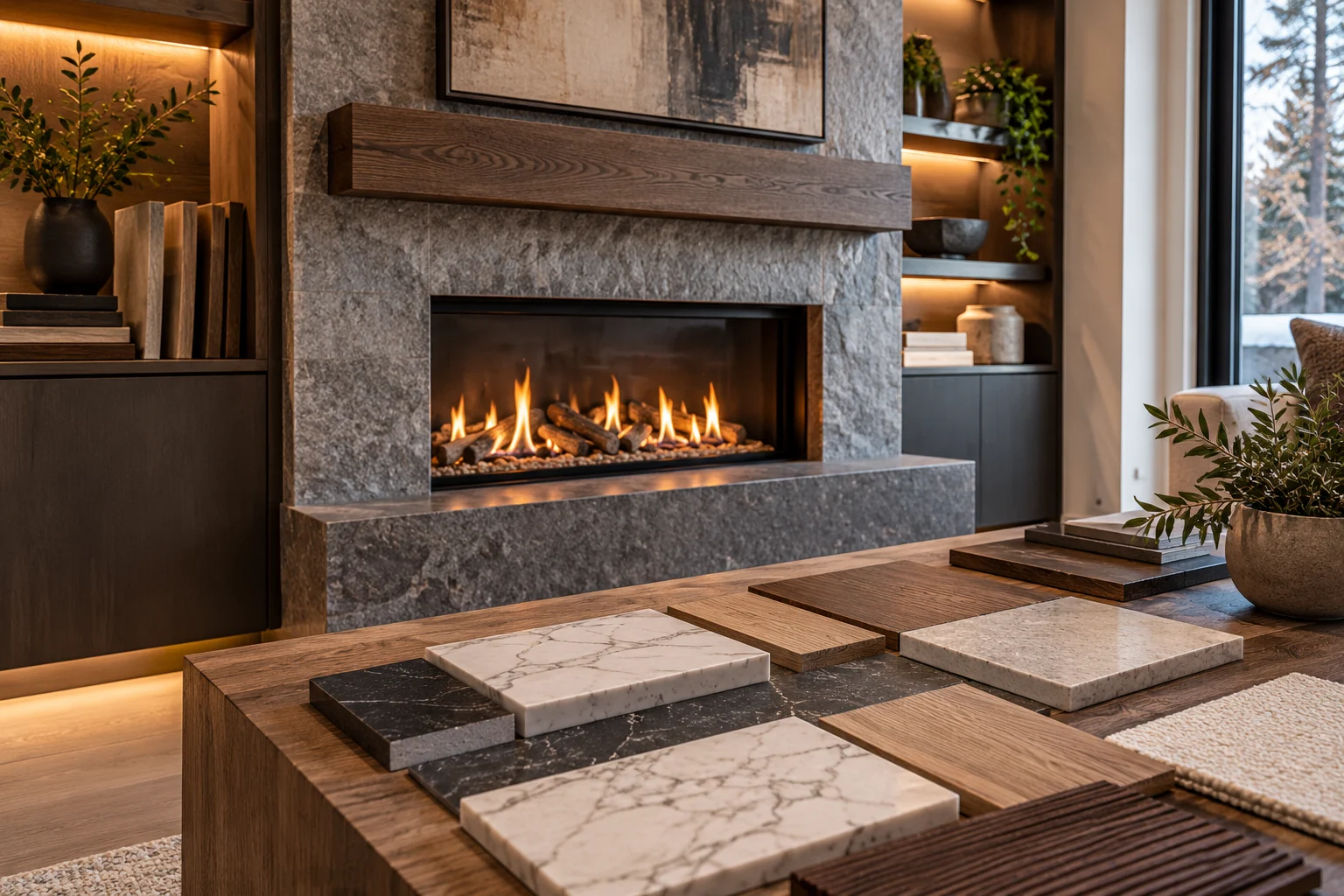
A fireplace wall asks questions of a material that no other surface in a house asks. It gets hot and then cold again, repeatedly — and it collects soot. It is lit from below by a moving light source, which exposes every trowel mark and every lippage. And part of it is subject to a rule that has nothing to do with taste: whether the material is combustible.
That last point is why material selection here cannot start from a mood board. A surface that is perfect two feet out from the opening may be prohibited six inches from it, and the difference is not negotiable.
This guide compares the realistic options on how they behave next to a fire: heat tolerance, soot, format, weight, fixing, cleaning and ageing. It is a materials guide. The design of the wall itself, the clearances that govern it, venting and the build sequence are covered in how to design a fireplace media wall with built-ins, and this article does not repeat them.
One question sorts the whole field
Is this material going inside the hot zone, or outside it?
Inside, the requirement is non-combustible, and the shortlist is short: natural stone, porcelain and sintered slab, ceramic tile, brick, concrete, mineral plaster, metal. Outside, almost anything is available, including timber, painted joinery and panelling.
Where that boundary falls comes from the appliance’s own installation instructions, not from a general rule and not from this article. Establish the line first, then choose materials for each side of it. Doing it the other way round is how people end up specifying a finish they cannot use where they wanted it.
A second question matters almost as much and is easier to overlook: how much heat actually reaches the surface. A sealed direct-vent gas unit, a wood-burning firebox and an electric unit produce very different conditions on the wall around them, and a material that is fine above one can discolour above another.
Natural stone
Still the default for a reason. It is non-combustible, it has genuine depth that printed surfaces struggle to match, and it ages in a way most people find acceptable. The differences between stones matter more here than they do on a horizontal surface, and for different reasons.
Two properties drive the choice. Porosity decides how readily the stone takes up soot and smoke residue. Thermal conductivity decides how quickly heat spreads through the material instead of concentrating in one spot, which is what makes thermal stress a design consideration rather than a theoretical one. Stones that move heat quickly cope better with a surface that is hot in one area and cool in another.
Granite
The most forgiving of the natural stones in this application. Dense, hard, comparatively low in porosity, and with notably higher thermal conductivity than marble or limestone, so heat distributes rather than concentrating. It takes soot less readily and cleans more easily. Sealing is still normal practice but the interval is long.
Its limitation is aesthetic rather than technical — which is not the same as unimportant. Heavily patterned granite reads as busy across a large uninterrupted wall, and a full-height media wall is a lot of surface on which to look at one pattern.
Marble and limestone
The look most people are actually after, and the pair that needs the most honesty about maintenance. Both are calcium carbonate, both are more porous than granite, and both have lower thermal conductivity, which means heat concentrates more locally.
Soot is the real issue rather than heat. A pale porous stone directly above a working firebox will pick up smoke residue, and on limestone in particular that shows as a gradual darkening across the area above the opening rather than as a distinct mark. Sealing with a penetrating impregnating sealer before first use is not optional on these stones, and the resealing interval is measured in a year or two rather than several.
Worth knowing: the acid-etching problem that makes marble difficult on a kitchen counter, explained in the countertop materials guide, is largely irrelevant on a fireplace wall. Nobody puts lemon juice on a chimney breast. The vertical application removes the objection that rules marble out horizontally, which is why marble fireplaces outlive marble kitchens.
Travertine
Warm, characterful, and the most porous of the common choices because of its natural voids. Those voids can be filled at the factory or left open. Left open on a fireplace wall they collect soot and dust and are awkward to clean, so a filled and honed finish is the sensible specification if travertine is the look you want near a working fire.
Slate and soapstone
Both are quietly well suited and both are underused. Slate is dense, dark and textured, and its texture and colour disguise soot better than any pale stone can. Soapstone is exceptionally heat-tolerant, non-porous enough to be undemanding, and darkens over time with oiling, which some people want and others do not. Neither suits every room, but where the palette allows, they are the lowest-maintenance natural options.
Porcelain and sintered slab
The material that has changed fireplace walls most in the last decade, and technically the strongest performer available.
It is fired mineral with no resin in it, so it tolerates heat without the limitation that constrains engineered stone. It is effectively non-porous, so soot sits on the surface and wipes off instead of soaking in. It never needs sealing. It does not fade. And it comes in very large formats, which is the decisive advantage on a tall wall: a floor-to-ceiling surface can be achieved in a small number of pieces, or sometimes one, where stone or tile would need many.
Three things to understand before specifying it.
- Thickness follows the application. Thin formats around six millimetres are intended for wall cladding, where the substrate carries the load and the reduced weight genuinely helps. Thicker slabs exist for surfaces that have to span or carry an edge.
- The substrate has to be flat. Large-format material is unforgiving: any deviation in the wall shows as lippage between pieces, and the flatness tolerance quoted for slab installation is tight enough that most ordinary walls need levelling first. That is preparation work, and it belongs in the quote.
- Coverage behind the piece matters more here than elsewhere. Voids behind cladding on a heated wall can trap heat, and installers working on fireplace faces aim for near-complete mortar coverage rather than the spot fixing that might pass on an ordinary wall.
The pattern in most porcelain is printed on the surface layer rather than running through the body, which matters at cut edges and outside corners. The usual answer on a fireplace wall is a mitred corner, which brings the face material around the return so no core is exposed. It is skilled work. Porcelain is brittle where the mitre tapers to nothing, and a badly machined cut loses the arris, so it is worth asking who is fabricating rather than only what is being supplied.
Engineered quartz, and why it is the wrong choice here
This deserves its own section because it is the most common expensive mistake on a fireplace wall, and it is usually made for an understandable reason: the quartz was already chosen for the kitchen and continuing it into the living room seems coherent.
Engineered quartz is mineral aggregate held together by a polymer resin. The resin is the problem. Sustained heat discolours it, and manufacturers’ technical guidance on this application is cautious in a way it is not about kitchens, citing surface temperatures in the region of ninety to a hundred degrees Celsius as the point at which the application needs thinking about rather than assuming. The failure modes named are discolouration, warping, cracking and seam failure, and they are not reversible.
The practical position: not directly around a firebox opening. Further out on the wall, beyond the appliance manufacturer’s stated clearances and with the quartz manufacturer’s own guidance checked, it can sometimes be used. That is a narrower permission than most people assume, and it depends on two separate manufacturers agreeing rather than on a general rule.
Where the aim is genuinely to carry one surface from the kitchen through to the fireplace, porcelain achieves it without the constraint, and many quartz ranges have close porcelain equivalents.
Tile
Still the most flexible option and the one with the widest range of results, from very good to obviously cheap.
Porcelain and ceramic tile are non-combustible and perfectly suitable. What separates a convincing tiled fireplace from a disappointing one is rarely the tile itself. It is the joint layout, the grout colour and the edges. A wall of small tiles is a wall of grout lines, and grout above a working firebox discolours faster than the tile does.
Two specific choices lift the result. Setting out the tile so that full tiles land at the firebox opening and any cuts go to the perimeter, and choosing a grout close to the tile colour so the wall reads as a surface rather than as a grid. Natural-stone tile behaves like the parent stone rather than like ceramic, so a marble mosaic carries marble’s porosity in a format with a great deal of grout in it, which is worth thinking about before choosing it for a wood-burning fireplace.
Brick and thin brick
Brick is the original answer and has come back into favour, partly because a great many older houses have it already.
Full brick is structural and appears in existing chimney breasts rather than in new media walls. Thin brick, which is a slip of the face fixed to the wall like tile, gives the same appearance without the depth or the weight, and is what most new brick fireplace walls actually are. It is non-combustible, it handles heat without complaint, and its texture hides soot and imperfection well.
What to decide is the mortar, not the brick. Joint colour, joint profile and how far the mortar is raked back change the character of the wall far more than the brick colour does, and a German-smear or overgrouted treatment is a different material decision again. Brick is also porous, so a sealer is usual where a wood fire is in regular use.
Plaster finishes
The fastest-growing group, and the one where the differences between similar-sounding products are largest.
Venetian plaster is lime and marble dust, burnished in thin layers. It is mineral, it is genuinely durable, and it gives a surface with depth that reads as stone at a distance and as something softer close up. On a fireplace wall its advantage is seamlessness: no joints, no grout, and it can be taken around returns and into reveals without an edge detail.
Microcement is a thin cementitious coating giving a seamless concrete look. It handles temperature change well and, like Venetian plaster, removes the joint problem entirely. Both are applied over a prepared substrate, and on a fireplace wall that substrate needs to be the non-combustible board the appliance requires rather than ordinary plasterboard.
Limewash is the one to be careful with. It is a finish rather than a coating, it is thinner and softer than the other two, and it is less robust in a heat zone unless properly sealed. It suits a wall away from the opening better than the area immediately around it.
All three are applied by hand, which means the result depends on the applicator to a degree that does not apply to a slab. Ask to see finished work in the specific product, in daylight and with a light raking across it, because that is how a fireplace wall is lit in the evening and it is unforgiving of an uneven hand.
Concrete and metal
Two minority choices that are right in specific rooms.
Cast concrete gives a monolithic result and can be made to almost any shape, including a hearth and surround as one piece. It is heavy enough to be a structural consideration, it is porous and wants sealing, and hairline crazing is normal behaviour in the material rather than a defect. It suits people who want that and frustrates people who expected a uniform slab.
Metal, usually blackened or patinated steel, works as a frame around an opening, a hearth plate or a full panel. It is completely heat-tolerant, it reads as deliberate rather than decorative, and it takes fingerprints and shows dents. Its best use is as a defined element against another material rather than as the whole wall, because a large metal surface can feel cold in a room that is meant to be the opposite.
Timber and panelling, outside the zone
Timber, veneer, MDF and painted joinery are combustible, so they belong outside the boundary the appliance sets. Beyond it they are entirely legitimate, and on a media wall they usually do the work that makes the room feel finished rather than clad.
Fluted and slatted panelling is the common current choice, and it has a practical advantage beyond appearance: vertical relief catches the low light from a fire and from integrated lighting, which gives the wall depth in the evening. The specification points are the substrate behind it and how the flutes terminate at top and bottom, because an unresolved end to a fluted panel is the detail that gives away a cheap installation. How a run of joinery is composed around a fireplace is covered in the living room built-ins guide. Cabinet materials and construction are covered in the complete guide to custom cabinets and built-in storage.
Format and joints
On a fireplace wall, format decides more about the finished appearance than colour does, and it is the variable most often left to the supplier.
Large-format slab gives the quietest result: few joints, an uninterrupted field, and a surface that reads as one material. It costs more, it needs a flat substrate, and it needs access to get the pieces into the room. Tile and brick give texture and rhythm, and the joint pattern becomes part of the design whether or not it was designed. Plaster removes joints altogether.
Where joints exist, three decisions are worth making deliberately rather than discovering. Where the joints fall relative to the firebox opening, since a joint running straight out of a corner of the opening draws the eye to it. Whether the veining or pattern continues across a joint, which requires the pieces to be cut from adjacent material. And how the material turns an external corner: a mitred corner keeps the face material running round, while a butt joint shows the thickness and the core.
Ask to see a layout drawing with the joints marked before anything is cut. It is the same discipline that applies to a countertop, and for the same reason: once the material is cut, the joint positions are permanent.
Finish, seen under the light it will actually have
Fireplace walls are looked at in the evening, lit from below by flame and often washed by integrated lighting close to the surface. That is grazing light, and it is the most revealing light there is.
Polished surfaces reflect it, which can look rich or can bounce a distracting highlight straight back at the seating. Honed and matt surfaces absorb it and show the material’s own colour. Textured, split-face and fluted surfaces dramatise it, throwing small shadows that make the wall look deeper than it is. None is correct — but choosing a finish under showroom downlights and then installing it above a fire is how people end up surprised.
Grazing light is also unforgiving of flatness, which is a second argument for getting the substrate right and a caution against heavily textured finishes on a wall that is not true.
Weight, substrate and fixing
Cladding a wall in stone is not the same as tiling a bathroom, and the difference is weight.
Full-thickness stone and full brick need a structure that can carry them, and on a new stud wall that means the framing and sometimes the floor beneath were designed for it. Thin stone veneer, thin brick and thin porcelain shift most of the load question away, which is a large part of why they dominate new work. Whatever the material, the substrate in the hot zone is the non-combustible board the appliance specifies, and that is settled at framing rather than at finishing.
Two failure modes are worth knowing about because they are invisible until they are not. Insufficient adhesive coverage behind a piece leaves voids, and voids on a heated wall are where cracking starts. And a substrate that is not flat produces lippage between large pieces, which no amount of skill at the fixing stage recovers.
Soot, marking and cleaning
How a wall looks in year five is mostly a function of two things: how porous the surface is, and what kind of fire is burning.
A sealed direct-vent gas appliance puts essentially nothing onto the wall, because combustion is contained and exhausted outside. An electric unit puts nothing on it at all. A wood-burning fireplace is a different proposition: it produces soot, and over years that deposits on the surface above the opening whether or not anyone notices it happening. Porosity then decides whether the residue sits on top and wipes off, as it does on porcelain and dense stone, or works in, as it does on limestone, travertine and unsealed brick.
Cleaning follows the same logic as any mineral surface. Neutral cleaner and a soft cloth. Avoid acidic and descaling products on calcium-carbonate stones, which includes marble, limestone and travertine, and avoid abrasives on anything polished. Where soot has worked into a porous stone, the remedy is a poultice rather than scrubbing, and it is a specialist job rather than a weekend one.
How each material ages
Worth thinking about explicitly, because a fireplace wall is not a surface anyone replaces casually.
- Porcelain and sintered slab essentially do not change. That is the appeal and, for some people, the objection.
- Granite and slate change very little, and what changes is easy to clean off.
- Marble, limestone and travertine develop a patina and, near a wood fire, darken above the opening. Accepted, this is character; unexpected, it is a complaint.
- Brick ages well and is the material most tolerant of looking used.
- Venetian plaster and microcement hold up if sealed and maintained, and both can be repaired and recoated, which few of the others can.
- Soapstone darkens deliberately with oiling, which is the point of it.
- Metal patinates, showing handling and heat, which is either the intention or an irritation.
What actually drives the cost
Material rate per square metre is the number people compare and the one that explains least. Four other factors move the total more.
- Format. Large slabs cost more to buy, handle and install, and they need access. A wall in one piece and the same wall in tile are different projects.
- Fabrication. Mitred corners, returns into reveals, cut-outs around an opening and continued veining across joints are all skilled operations. A flat field with butt joints is a fraction of the work.
- Substrate preparation. Levelling an out-of-true wall to the flatness large-format material needs is real work that rarely appears in an early estimate.
- Labour rate for the specific finish. Hand-applied plaster and fine stone work are priced on skill, not on area.
Which is why two quotes for “stone fireplace wall” can differ enormously and both be honest. Compare the scope, not the rate.
Matching the material to the appliance
The appliance narrows the field before taste does.
A wood-burning fireplace is the demanding case: the most heat, and soot. Dense, low-porosity, forgiving surfaces earn their place here, which means granite, slate, porcelain, brick or a well-sealed dark stone, and it is the case where pale limestone directly above the opening will eventually disappoint.
A direct-vent gas unit is sealed, so soot is not the issue. Radiant heat at the glass is, and it is concentrated immediately around the opening, which is where the material choice actually matters and where the appliance’s clearances apply.
An electric unit imposes the least. Its clearances are smaller and there is no combustion at all, which is why electric installations carry the widest range of finishes, including plaster and, beyond the unit’s own stated clearances, materials that would be questionable elsewhere.
In every case the figures come from the appliance’s documentation. Which appliance to choose, and what it demands of the structure, is the subject of the fireplace media wall design guide.
Materials across the GTA
Housing stock changes which materials are practical more than it changes which are fashionable.
Newer houses in Vaughan and Richmond Hill often have double-height great rooms, and that scale is where large-format porcelain earns its cost: a two-storey wall in tile is a very large amount of grout, and the same wall in a few slabs reads completely differently. Tall walls also make flatness harder, so substrate preparation is a bigger line than people expect.
In Markham, open-plan family rooms mean the fireplace wall is read from the kitchen as well, so the material often has to sit in a conversation with the kitchen finishes rather than stand alone. This is exactly where people reach for the kitchen quartz and where porcelain is the better way to achieve the same continuity.
Older Toronto houses usually start with an existing brick chimney breast, so the real decision is whether to keep and clean the brick, plaster over it, or clad it. Plaster directly over brick is a genuine option that avoids demolition entirely. Access also matters in narrow houses: a slab large enough for the wall has to physically reach the room, and on a tight staircase that alone can settle the format question.
Common mistakes
- Choosing the material before establishing where the non-combustible boundary falls.
- Carrying the kitchen quartz onto the fireplace wall and running it up to the opening.
- Pale porous limestone directly above a working wood fire, with no sealer and no expectation of darkening.
- Unfilled travertine near a fire, then finding the voids hold soot.
- Specifying large-format slab without pricing the substrate levelling it requires.
- Accepting spot fixing behind cladding on a heated wall instead of near-full coverage.
- Leaving the joint layout to the installer, then finding a joint running out of the corner of the opening.
- Butt-jointing an external corner in porcelain so the printed face stops and the core shows.
- Grout in a contrasting colour, turning a tiled wall into a grid.
- Choosing a finish under showroom downlights rather than under grazing light.
- Limewash in the hot zone, where it is the least robust of the plaster finishes.
- Applying plaster or microcement over ordinary board instead of the non-combustible substrate.
- Ordering a slab that cannot physically be carried into the room.
- Using acidic or descaling cleaners on marble, limestone or travertine.
Questions worth asking
- Is this material approved for use at the distance from the opening where I want it?
- What substrate is going behind it in the hot zone?
- Does the existing wall need levelling first, and is that in the price?
- Can I see a layout drawing with every joint marked before anything is cut?
- How are external corners handled, mitred or butted?
- Does the pattern continue across joints, and does that need extra material?
- What adhesive coverage is being achieved behind the cladding?
- Does this stone need sealing, with what, and how often?
- What finish is it, and can I see it lit from below rather than from above?
- Can the pieces physically get into the room?
- For a hand-applied finish, can I see completed work by the person who will actually apply it?
- What is excluded: substrate, levelling, sealing, the hearth, the returns?
Frequently asked questions
What is the best material for a fireplace wall?
There is no single answer, but the field narrows quickly once two things are known: where the non-combustible boundary falls, and what kind of appliance is behind the wall. For a wood-burning fireplace, dense low-porosity surfaces earn their place because of soot, which means granite, slate, porcelain, brick or a well-sealed dark stone. For a sealed direct-vent gas unit, soot is not a factor and radiant heat around the opening is, so the material choice matters most in that immediate band. Porcelain and sintered slab are the strongest all-round technical performers; natural stone has depth that printed surfaces struggle to match.
Can quartz be used around a fireplace?
Not directly around the opening. Engineered quartz is mineral aggregate held together by polymer resin, and sustained heat discolours the resin, with manufacturers’ technical guidance treating surface temperatures around ninety to a hundred degrees Celsius as the point where the application needs real consideration. The named failure modes are discolouration, warping, cracking and seam failure, none of them reversible. Further out on the wall, beyond the appliance’s stated clearances and with the quartz manufacturer’s own guidance checked, it can sometimes be used. If the aim is to continue a kitchen surface into the living room, porcelain achieves that without the constraint.
Will a marble or limestone fireplace get dirty?
Above a wood-burning fire, yes, gradually. Both are porous calcium-carbonate stones, and soot deposits on the area above the opening over years, typically showing as a slow darkening rather than a distinct mark. Sealing with a penetrating impregnating sealer before first use is essential, and the resealing interval is short compared with granite. Above a sealed gas or an electric unit there is effectively no soot, and the same stone behaves very differently. Where soot has worked into the stone, removal is a poultice job for a specialist rather than something to scrub.
Is marble a bad idea on a fireplace the way it is on a kitchen counter?
No, and this is a genuine difference between the two applications. What makes marble difficult in a kitchen is acid etching, the chemical reaction between acidic foods and the calcium carbonate in the stone. On a fireplace wall nothing acidic is ever put on the surface, so the objection largely disappears. What remains is porosity and soot, which sealing addresses. A vertical, low-contact, non-food surface suits marble far better than a worktop does.
Porcelain slab or natural stone?
Porcelain wins on performance and on format. It has no resin, so heat is not a limitation; it is effectively non-porous, so soot wipes off and it never needs sealing; and it comes in very large sheets, so a floor-to-ceiling wall can be done in a few pieces rather than many. Natural stone wins on depth, because the material goes right through rather than being printed on a surface layer, which shows at cut edges and corners. Porcelain also demands a flatter substrate and a fabricator experienced with brittle thin material, particularly for mitred corners.
Can I plaster over my existing brick fireplace?
Usually, and it is one of the more attractive options in older housing because it avoids demolition entirely. Venetian plaster is a lime-and-marble-dust material and takes to masonry well, and microcement gives a seamless concrete look over the same substrate. Both need the brick prepared properly first, and in the hot zone the requirement for a non-combustible substrate still applies, which existing brick satisfies. What to check is the condition of the brick and mortar, and whether the chimney breast is sound, before committing to a finish that will be difficult to reverse.
Can wood or panelling go on a fireplace wall?
Outside the clearance boundary, yes, and it is very common. Timber, veneer, MDF and painted joinery are combustible, so they belong beyond the line the appliance’s instructions set, with non-combustible material inside it. Fluted or slatted panelling works particularly well on this wall because the vertical relief catches low evening light and firelight and gives the surface depth. The details that decide whether it looks considered are the substrate behind it and how the flutes are terminated at top and bottom.
Does tile look cheap on a fireplace?
It can, and the cause is almost never the tile. It is the joint layout, the grout colour and the edges. Setting out so full tiles land at the firebox opening and cuts go to the perimeter, and choosing a grout close to the tile colour so the wall reads as a surface rather than a grid, lifts the result substantially. Be aware that grout above a working fire discolours faster than the tile does, and that natural-stone tile behaves like its parent stone, so a marble mosaic carries marble’s porosity in a format with a great deal of grout in it.
Why do quotes for the same fireplace wall vary so much?
Because the material rate per square metre explains the least of the total. Format drives it, since large slabs cost more to buy, handle, move into the room and install. Fabrication drives it, because mitred corners, returns, cut-outs and veining continued across joints are skilled operations that a flat butt-jointed field does not involve. Substrate levelling drives it, and it rarely appears in an early estimate. And hand-applied finishes are priced on skill rather than area. Two honest quotes can differ substantially, so compare the scope rather than the rate.
How do I clean a stone fireplace surround?
Neutral cleaner, warm water and a soft cloth for routine cleaning. Keep acidic and descaling products away from calcium-carbonate stones, meaning marble, limestone and travertine, because they react with the surface itself. Keep abrasives away from anything polished. Resealing intervals belong to the individual stone rather than to a universal timetable, running short on marble and limestone and long on granite. Porcelain and sintered slab need none of this. For soot that has worked into a porous stone, the remedy is a drawing poultice rather than scrubbing, and it is specialist work.
In short
Find the non-combustible boundary before choosing anything, then specify for each side of it separately. Inside, work from the shortlist of mineral materials and let the appliance type narrow it: soot argues for dense and forgiving, radiant heat argues for something that does not rely on a resin.
Keep engineered quartz away from the opening. Seal the porous stones and know how they will look in five years. Decide the format and the joint layout deliberately, because they change the wall more than colour does. Get the substrate flat and the coverage behind the cladding right, since both failures are invisible until they are permanent.
Then look at the sample the way you will actually see the wall: at night, lit from below, with the fire on.
Choosing finishes for a media wall in Toronto or the GTA? Our fireplaces and media walls page covers this work, and a consultation is the quickest way to get samples in front of you against the actual appliance and the actual light. See also how we run a project and examples of completed work.